

Growing Retail through Referral
Your best salespeople probably do not work in your branch.
They bank here. They already tell people where to go for a car loan, and they do it for free, about four times a year each.
A branch is not a building
For a big bank a branch is a location. A logo, a lobby, a sign off the highway.
That is not what a branch is in your towns.
A branch is a collection of relationships. Customers who know your tellers from church, from the school board, from the line at the gas station. Those people are already recommending you. They do it in a parking lot, to one person at a time, and it never shows up anywhere.
That is your growth asset. Generic advertising buries it.
The Mechanics of Locally Famous
Recognizable Employee + Geo-targeting + Meaningful Message.
Pick one banker and one town. Build around what that person actually knows and the people who already know them. Their face, their name, their answers to the questions they get asked every week.
Then the targeting works. Geography down to the roads that feed that branch. Lifestyle data to find who fits the product. Search behavior to catch who's already looking. Stacked, those layers reach the right prospect for pennies. Spend small, because precision means you don't need scale. Count loans and accounts, not impressions. Then do it again in the next town.
Nobody opens an account through an ad
That is a hard thing to say to bank marketers, and it is exactly why we have always used incentives. The toaster. The Tupperware. In this program, $25. Something has to activate the behavior. That part was never wrong.
What we were paying for was.
Somebody who signs up for a toaster leaves for a quarter point. You bought a transaction at retail.
A referral is different. It is the strongest lead a bank gets and always has been. So pay for that instead, on both sides. The customer who sends someone, and the person they send.

The equation
A person you recognize + a service you need + a small but meaningful incentive.
Then the digital half, which exists only to make that ask efficient.
Geotargeted to the town it belongs to. Not the county, not the region.
Personalized to the branch manager who actually works there. A face, not a logo.
Captured, so the referral gets logged and the referrer actually gets paid.
Counted, against what your core system verified.
Old-school relationship banking, the backbone of community banking, on a system that can be tracked, scaled and held accountable.
How it runs - Ninety days, four phases.
Phase one. Two weeks. Setup.
We pick the branches with you. Then one working session, about an hour, with those branch managers and whoever owns marketing. We settle three things: the incentive amount, what qualifies as a referred account, and who inside the bank owns the payout.
That third one sounds administrative. It is the single most common point of failure.
We photograph each branch manager. No studio, no crew. The point is that they look like the person a customer met last Tuesday.
Phase two. Two weeks. Build.
A page per branch, built around the person who works it. Their name, their photo, the town named on the page.
A capture step that logs the referral at the moment it happens. This is what separates a program that pays people from a program people stop trusting. It has to work at the counter and on a phone, and it has to write to something your staff can actually see.
A referral mechanic your staff can hand someone. Physical, simple, no training session required.
Campaign build across Google and Meta, geofenced to each branch's trade area.
Phase three. Ten weeks. In market.
Campaigns run and get managed. Budget moves between branches only after the first thirty days, and only for delivery reasons, never to chase a winner. Each branch keeps its own budget line so the comparison stays clean.
At day thirty we send a short read. Not a report. Delivery, clicks, page traffic per branch, and anything that looks broken.
Phase four. Day ninety. The count.
One report. Referred accounts your core system verified, per branch, with a cost per verified account.
Not page visits. Not platform conversions. Accounts.
What it produced
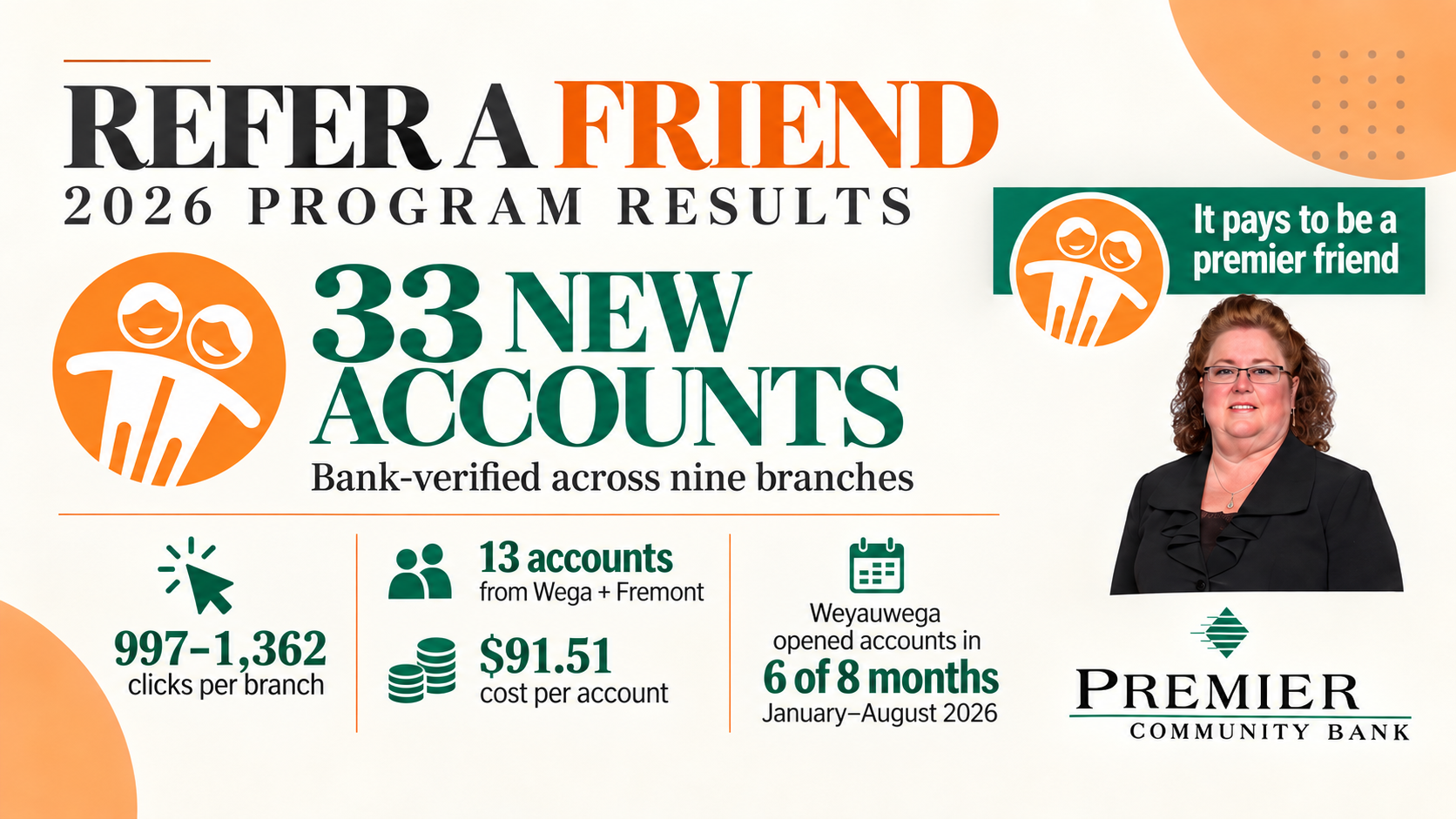
Nine branches. Eight months. $10,750 in media.
33 verified referrals. $325.76 each in media.
That number is a floor, not a total. Somebody who saw an ad in their town, thought about the bank, walked in and opened an account without mentioning a referral appears nowhere in it. There is no way to know how many of those there were, so we do not guess. The real figure is better than $325.76 and we cannot tell you by how much.
One we did not expect: of the people who reached the referral page, nineteen percent became a paid referral. Nearly one in five.
What the spread told us
All nine branches got roughly the same budget. Clicks landed between 997 and 1,362 across every one of them, as close to identical as advertising ever gets.
Verified referrals ranged from one to thirteen.
The media was not the variable. It put the same stream of interested people into every town. What happened at the counter was completely different depending on the door.
A branch can score zero two different ways. Either nobody there promoted the program, or they opened referred accounts and never asked who sent them, so nothing got logged and the referrer never got paid. Those look identical in a report. They are entirely different problems.
The average tells you whether to keep spending. The spread tells you where to go look.
What this will not do
This amplifies what your people already do. It cannot manufacture it.
If nobody at a branch asks who sent you, nothing here will save it. We would rather say that now than in month three.
Contact Us
Interested in working together? Fill out some info and we will be in touch shortly. We can’t wait to hear from you!